 Loading...
Loading...
Loading...
Cannabis Science
Why the compounds in cannabis work better together than alone — and what the latest research actually says. A science-backed guide for NJ dispensary shoppers.
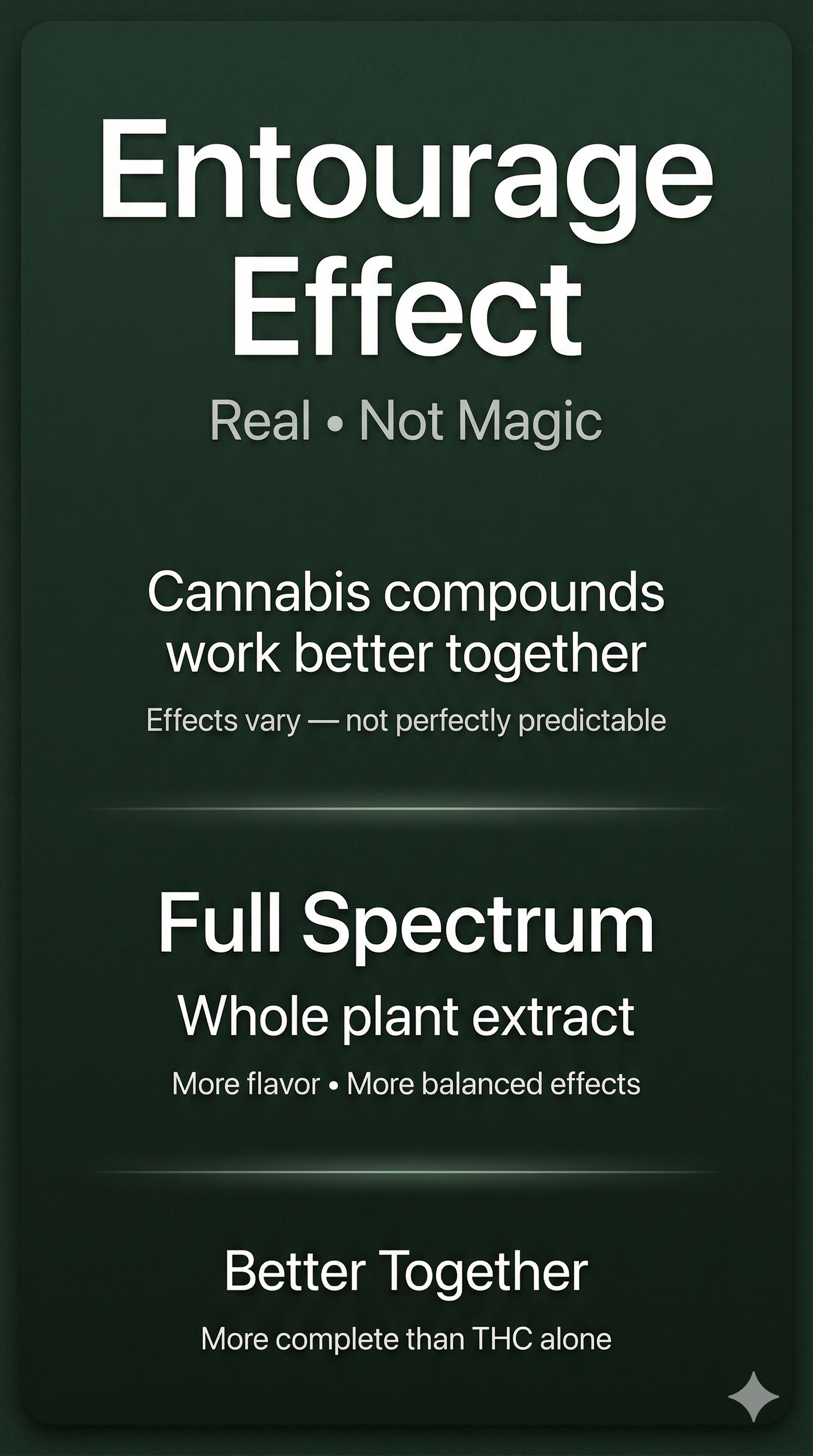
It's real, but it gets exaggerated by marketing. Here's the straightforward breakdown.
It's not fake, but scientists consider it a highly supported theory rather than a settled law of physics.
The science: We know for a fact that certain compounds in cannabis change how THC affects you. For example, clinical trials have proven that the terpene limonene physically alters how your brain processes THC, reducing the paranoia and anxiety that THC alone can cause. [Source]
The hype: Brands sometimes treat it like magic, claiming a specific mix of compounds will perfectly cure your sleep issues or make you instantly creative. The science isn't precise enough to guarantee those specific outcomes for everyone yet.
"Full spectrum" is simply a factual description of how a product was made.
What it means: The manufacturer extracted oils from the plant without stripping away the natural terpenes and minor cannabinoids. You're getting the whole plant's chemical profile.
Why it matters: Research consistently shows that full-spectrum extracts work better, and at lower doses, than pure isolated THC or CBD. [Source] When you strip everything away except THC (which is what "distillate" is), the high becomes flat, one-dimensional, and often builds tolerance faster.
The entourage effect and full-spectrum products are real science, not fake stoner myths. The compounds in cannabis genuinely work better as a team than they do alone. Just keep in mind that dispensary marketing might oversell exactly how perfect that teamwork is.
A deeper look at the mechanism behind the entourage effect.
THC alone produces a high. But when paired with terpenes like myrcene and cannabinoids like CBD, the experience shifts — calmer, more focused, or more physical depending on the mix.
Cannabis contains 100+ cannabinoids and 200+ terpenes. The entourage effect says these compounds modulate each other — enhancing benefits, reducing side effects. It's not about one star player. It's about the full cast.
The concept was first described in 1998 by Raphael Mechoulam and Shimon Ben-Shabat, who observed that inactive compounds boosted the effects of active ones in the endocannabinoid system.
This is why a 75% THC live resin cart can feel stronger than a 92% distillate. The supporting compounds change how THC interacts with your body. The percentage on the label is not the whole story.
No jargon. Here are the key findings that matter if you're buying cannabis — what's proven, what's not, and what it means for you.
Johns Hopkins ran a gold-standard clinical trial in 2024. People who inhaled the terpene limonene alongside THC experienced significantly less anxiety, nervousness, and paranoia — while the good effects of THC stayed the same. This is one of the first human trials proving a terpene physically changes how THC affects your brain. [Johns Hopkins, 2024]
What this means for you: If a strain makes you anxious, the problem might not be THC itself — it could be that the product is low in terpenes like limonene. Products with richer terpene profiles may give you the benefits without the paranoia.
A JAMA Psychiatry study tested 121 cannabis users — some used flower (16-24% THC), others used concentrates (70-90% THC). Concentrate users had more than double the THC in their blood, but their self-reported high, balance, and cognitive impairment were the same as flower users. Your body hits a ceiling. [JAMA Psychiatry, 2020]
What this means for you: Chasing the highest THC number on the shelf is a waste of money. A 24% flower can feel the same as a 90% concentrate. Pick products by their terpene and cannabinoid profile instead.
Researchers compared pure CBD isolate to a full-spectrum CBD extract. The isolate only worked at one narrow dose — go higher and it stopped working entirely. The full-spectrum extract kept getting more effective at higher doses, hitting 64% inflammation reduction where the isolate dropped to 14-28%. [Frontiers in Neurology, 2018]
What this means for you: If you use CBD for pain or relaxation, full-spectrum products are more forgiving and predictable than isolates. With isolate, there's a narrow sweet spot — full spectrum gives you a wider effective range.
Researchers tracked 6,309 real-world cannabis sessions from 204 patients and sorted products by their actual chemical makeup instead of strain names. Different chemical profiles showed statistically significant differences in treating pain, anxiety, and depression. One profile actually made anxiety worse. [Journal of Cannabis Research, 2023]
What this means for you: "Blue Dream" from one grower can have a completely different chemical makeup than "Blue Dream" from another. Ask your budtender about the lab results (COA), not the strain name.
A 2024 clinical trial gave 37 people a high dose of CBD (450mg) alongside THC. CBD did not reduce the high or side effects — it actually increased THC's psychoactive effects by 60%. Lower CBD doses (10mg, 30mg) made no difference at all. [Clinical Pharmacology & Therapeutics, 2024]
What this means for you: Don't assume a 1:1 THC:CBD product will be milder. If you want less intensity, lower your THC dose — CBD isn't an off switch.
A comprehensive 2024 review of all existing research concluded the entourage effect is a "productive hypothesis with partial clinical support" — not a proven fact. The evidence is real and growing, but most of it comes from lab studies and observational data, not large-scale human trials. The full theory hasn't been tested end-to-end yet. [Pharmaceuticals, 2024]
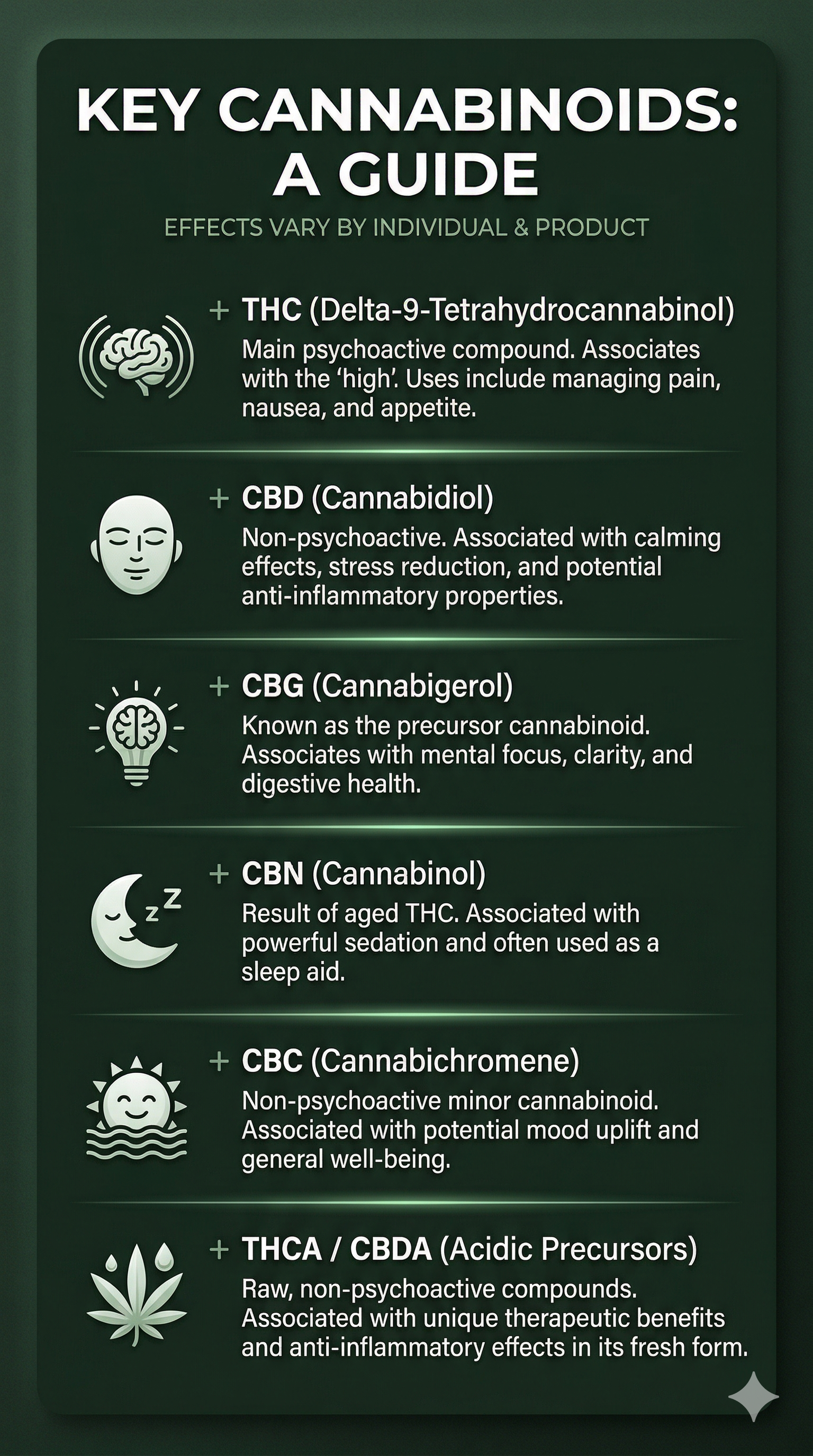
THC gets the headlines, but the supporting cast is what shapes the experience. Here are the cannabinoids that matter most.
Minor cannabinoids are present in small amounts but research suggests they play outsized roles in modulating the overall experience through receptor interaction and enzyme inhibition.
Terpenes are aromatic compounds found in all plants. In cannabis, they do far more than create flavor — they actively shape the high.
The entourage effect is the reason "full spectrum" matters — and why product type directly impacts your experience.
Full Spectrum Carts — In Stock Now
How to use the entourage effect to make smarter purchasing decisions at any NJ dispensary.
Read the label. Look for terpene percentages on the package. Products with 5%+ total terpenes deliver a noticeably richer experience than those with 1-2%. If the label doesn't list terpenes at all, assume they're minimal.
Stop chasing THC percentage. A 75% live resin with 10% terpenes will likely feel stronger and more complex than a 92% distillate with 2% added terps. The number on the package is not the whole story.
Ask two questions. "Is this full spectrum?" and "Are the terpenes cannabis-derived or botanical?" These reveal how much entourage effect you're actually getting. Cannabis-derived terpenes (CDT) maintain natural ratios. Botanical terpenes (BDT) are approximations.
Flower is the simplest path. If maximizing the entourage effect is your goal, whole flower gives you the complete, unaltered chemical profile of the plant — nothing removed, nothing added.
Misconceptions about the entourage effect that we hear regularly at the dispensary counter.
While some brands overuse the term, the underlying science is real. Peer-reviewed studies consistently show that whole-plant extracts outperform isolates in both potency and therapeutic outcomes.
Not exactly. The entourage effect is about the right combination, not the most. Some terpene profiles work better for sleep, others for focus. It's about matching the profile to your needs.
Distillate serves a purpose — it's affordable, potent, and consistent. But if you want the full-spectrum experience, you need to look beyond THC percentage alone.
CBD doesn't eliminate THC's effects — it modulates them. It can reduce anxiety and paranoia while preserving euphoria and pain relief. Think of it as a thermostat, not an off switch.
Quality varies enormously. Strain genetics, harvest timing, freezing speed, and extraction technique all affect the final terpene and cannabinoid ratios. Brand and source matter.
Whole Flower — In Stock Now
The claims in this article are supported by peer-reviewed research. Here are the key studies cited.
Disclaimer: This article is for educational purposes only and does not constitute medical advice. The research cited is intended to inform, not to diagnose, treat, cure, or prevent any condition. Cannabis affects everyone differently. Consult a healthcare professional before making decisions about cannabis use, especially if you have existing health conditions or take medications. The Canna Bar does not make medical claims about any products sold.