 Loading...
Loading...
Loading...
Cannabis Culture
Every year on April 20, the whole cannabis world lights up at 4:20 PM. But the real origin of "420" is a lot weirder — and a lot more human — than most people think. Here is the real story, told straight from the counter at The Canna Bar in Matawan, NJ.

Image credit: GrowDiaries
If you want the quick version before the long one, here it is.
"420" was invented by a group of teenagers in San Rafael, California, who called themselves the Waldos. They agreed to meet at 4:20 PM after school to hunt for an abandoned cannabis crop they had heard about. The crop never turned up, but the code word stuck.
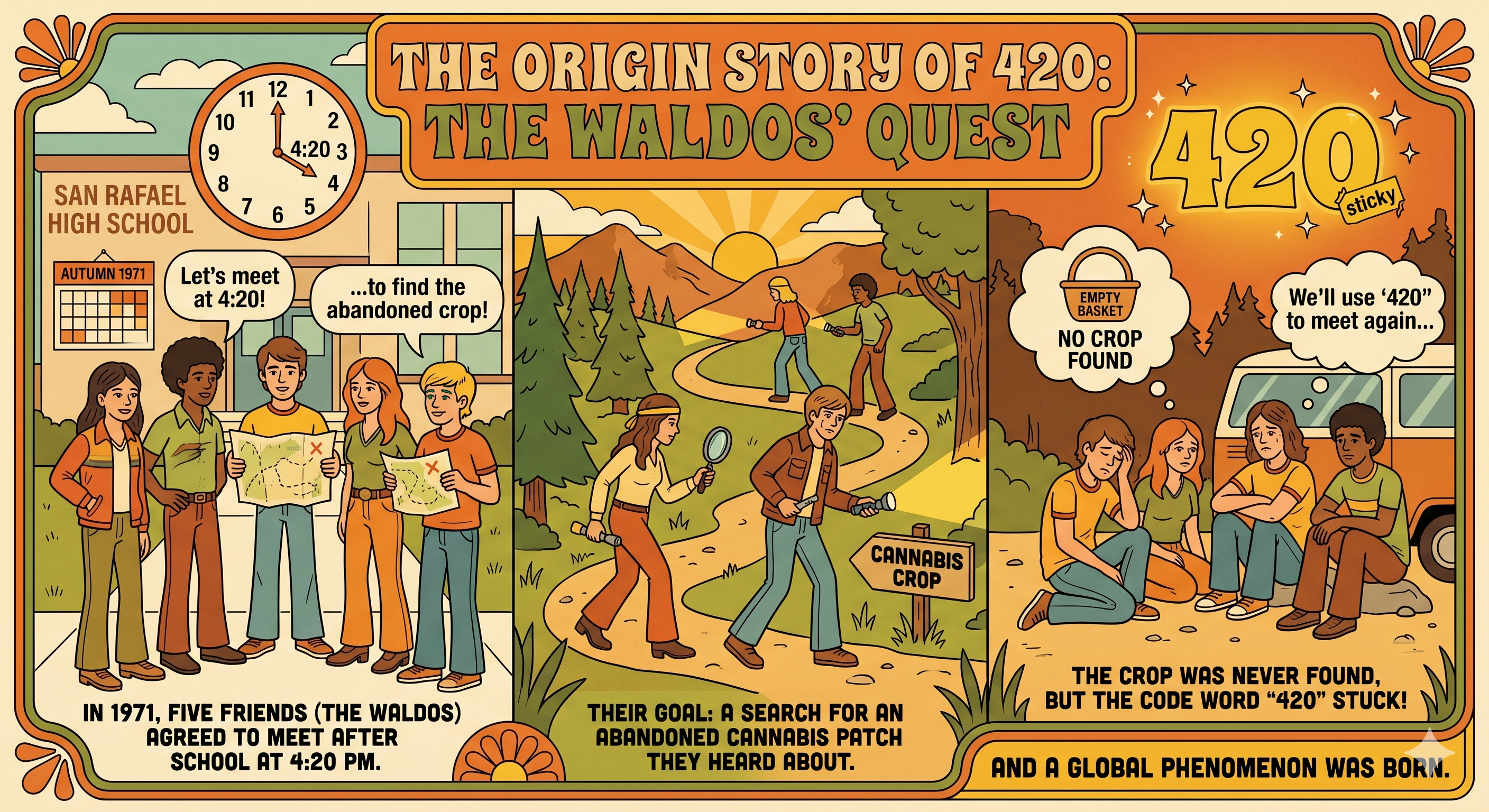
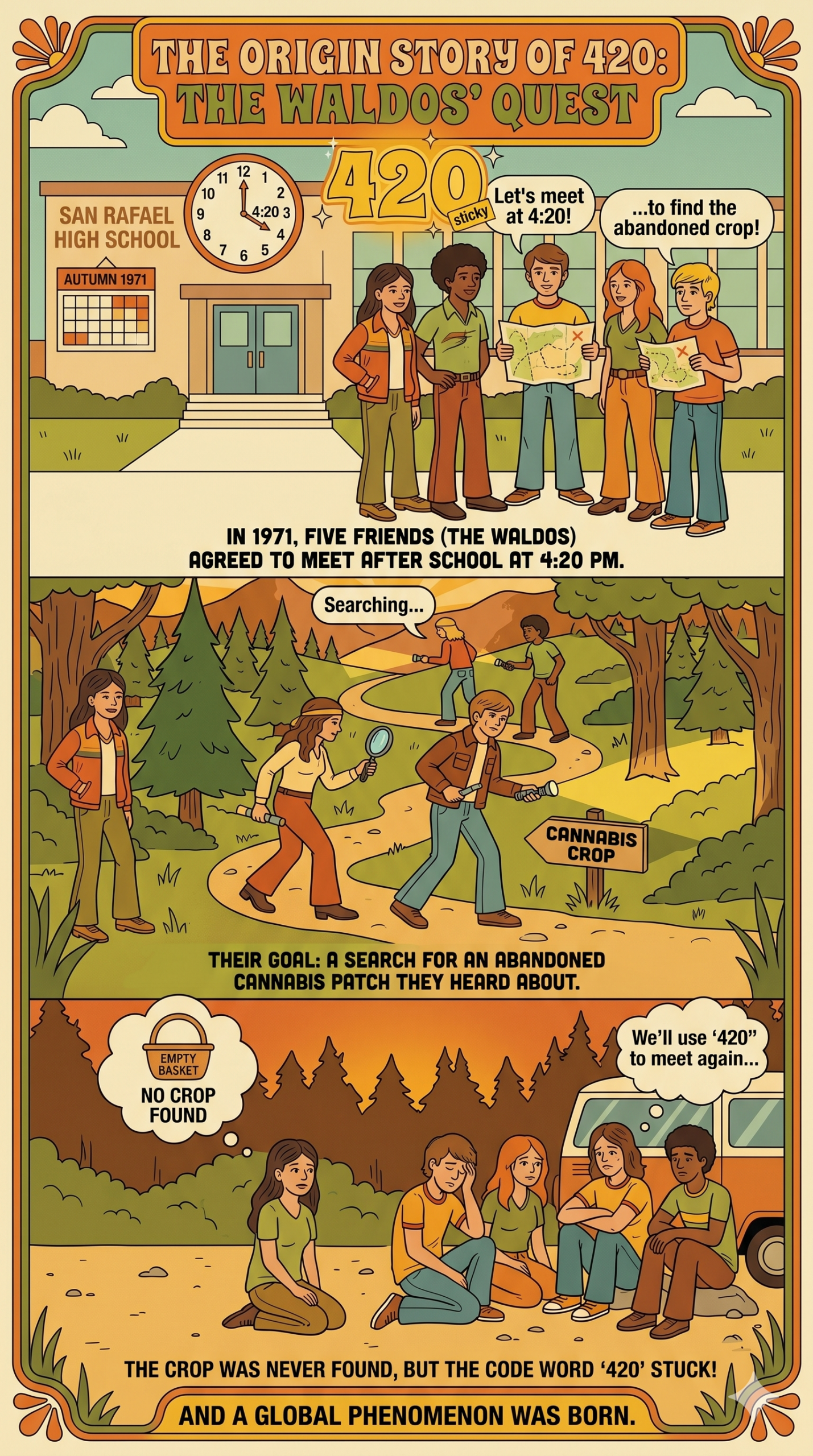
Some of the Waldos had ties to the Grateful Dead's inner circle. Through concerts, tours, and the band's massive fan network, "420" spread from a single California high school into the global cannabis vocabulary.
In the early 90s a flyer for a 4/20 gathering started circulating. High Times magazine printed it, and from that point on April 20 was locked in as the unofficial cannabis holiday.
A time of day, a date, a greeting, a reason to stop in, a reason to celebrate. It is the single most recognized number in cannabis culture — and it all started with five kids, one statue, and a treasure hunt.
The most widely accepted origin of "420" traces back to a real group of high school students at San Rafael High in Marin County, California.
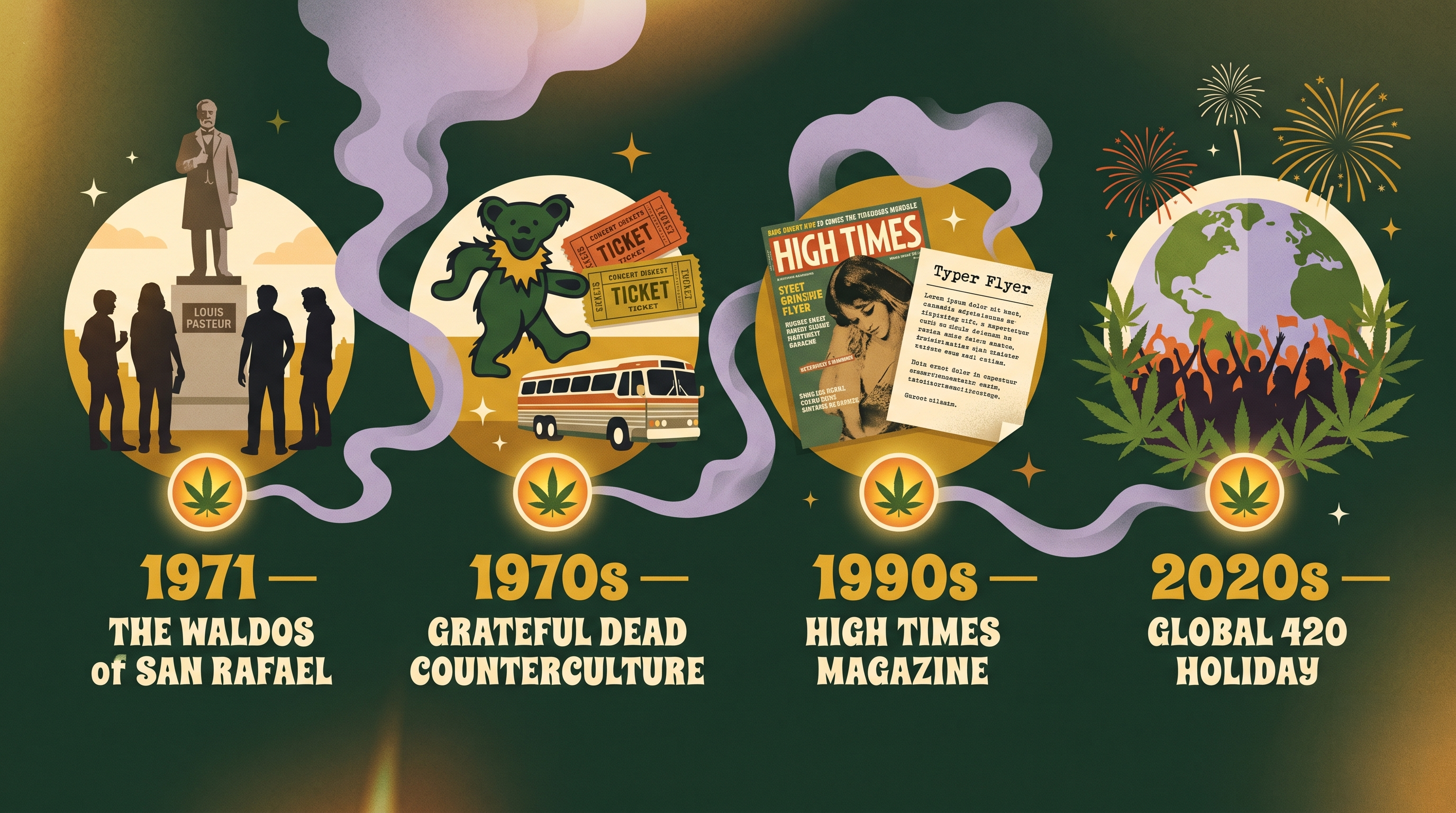
The five friends — Steve Capper, Dave Reddix, Jeffrey Noel, Larry Schwartz, and Mark Gravich — hung out near a wall on campus, so they nicknamed themselves the Waldos. They were athletes, they were funny, and they were extremely good at inventing their own slang.
In the fall of 1971, the group got their hands on a hand-drawn treasure map. The story went that a Coast Guard member had planted a cannabis crop in the woods near Point Reyes and could no longer tend to it. If the Waldos could find the patch, they could keep the harvest.
They agreed to meet after sports practice at the statue of Louis Pasteur on their school campus — every day at 4:20 PM. From there they would pile into a car, drive out to Point Reyes, and search the forest.
In the hallways they had to keep it quiet, so they shortened the meetup to a single code word. "Four-twenty Louis" became "4:20" became just "420." If a Waldo passed another Waldo between classes and said "420," both of them knew exactly what it meant.
They never actually found the crop. The treasure hunt quietly fizzled out. But the code word was too good to let go of — and by the end of the school year "420" had become shorthand for anything cannabis-related.
A code word between five friends should have died a quiet death in 1972. Instead it became a global greeting. The reason is one of the most famous bands in American history.
The Waldos had real access to the Grateful Dead's world. Dave Reddix's older brother managed a Grateful Dead sideband and was close friends with bassist Phil Lesh. Mark Gravich's father handled real estate for the band. A couple of the Waldos hung around backstage, at rehearsals, and at after-parties.
In that circle, "420" stopped being a high school joke and started being a grown-up word. It got used backstage, then on tour, then in the parking lot scene that followed the band from city to city. By the late 70s and 80s, Deadheads across the country were using it too.
Grateful Dead culture ran on bootleg tapes, underground flyers, zines, and word of mouth — all of it largely invisible to mainstream media but connecting hundreds of thousands of fans. That network carried "420" to every corner of the country the band played.
"420" worked as a code word for the same reason it still works today: it is short, specific, and deniable. You could say it in a hallway, over a phone, on a flyer, or on a t-shirt, and anyone in the know understood — without anyone outside the culture needing to.
A subculture word became a calendar date thanks to a single flyer that landed on the right desk.
In the early 1990s, a Deadhead handed out a flyer at a concert in Oakland. The flyer invited readers to meet on April 20 at 4:20 PM on Mt. Tamalpais — a mountain just north of San Rafael — to celebrate "420."
A copy of that flyer ended up at High Times magazine, then the most influential cannabis publication in the world. High Times printed the flyer in 1991 and began referencing "420" in its editorial coverage — Steve Bloom's reporting being the piece of record. From that point on, the number was locked to a specific date: April 20.
That was the moment "420" broke out of the underground. Once it was in print, it was in songs, in t-shirts, in stand-up sets, in stoner movies, in college dorms, and eventually in the legal dispensary industry itself.
By the time the first medical cannabis laws were passing in the late 1990s, 4/20 was already a national phenomenon. The industry grew up around it. Today every legal dispensary in New Jersey — The Canna Bar included — plans the year around that one date.
Five decades from a treasure map to a global holiday.
Fifty-plus years from a hand-drawn map in Marin County to a 55-foot glass storefront on Main Street in Matawan. The number moved with the culture the whole way.
One number, three different meanings — and all of them still in active use.
If you've heard one of these, you are in very good company. None of them check out.
You hear this one constantly. "420 is the California police code for marijuana possession." It is not. No such code exists — not in California, not anywhere. It's a clean, tidy myth with zero basis.
The plant contains roughly 100+ cannabinoids and 200+ terpenes, not "exactly 420 active compounds." The real number is neither round nor mystical. It's also still being revised as research catches up.
Bob Marley was born on February 6, 1945. He died on May 11, 1981. There is no connection between his life or music and April 20 — this one is pure internet telephone.
April 20 was Hitler's birthday. It is also a completely unrelated cannabis holiday. The overlap is pure coincidence — the Waldos picked 4:20 PM in 1971 with no awareness of the date. History has a sense of humor like that.
You may have heard that 420 comes from "Rainy Day Women #12 & 35" because 12 × 35 = 420. Fun math, no connection — the song predates the Waldos by five years and has nothing to do with cannabis slang.
Some versions claim the Dead always stayed in room 420 on tour. The Waldos came first and the band adopted the code from them, not the other way around. Good story, wrong order.
The Canna Bar opened its doors on April 20, 2025. That means every 4/20 is also our anniversary — and we take it personally.
We treat 4/20 as the biggest day of our year. Every one of our 100+ brand partners shows up with deals, exclusive drops, budtender-favorite picks, and limited-release product. Our buying team spends months planning the menu for that one Monday.
What you can expect from us every April 20:
In-store pickup only — order ahead on the Canna Bar menu to skip the line, or walk in and let a budtender guide you through the deals live. Either way, it's the best day of the year to visit us.
4/20 Favorites — In Stock Now
Live Resin Carts — In Stock Now
A note on the history: The Waldos origin story is the version supported by firsthand evidence and mainstream historical reporting. Other origin claims exist, but none of them hold up to the paper trail the Waldos have preserved. Cannabis culture has always been full of folklore — this article sticks to what can actually be documented.